 Matt Ruckman
The Universe Is Hanging from Something
Or: What Happens When a 13th-Century Friar and a 21st-Century Physicist Both Look Down and Notice There's No Floor
Two things happened to me recently that I cannot stop thinking about, and they both happened on YouTube.1
The first was a Big Think interview with Dr. Michelle Thaller, an astronomer at NASA's Goddard Space Flight Center, in which she calmly, almost conversationally, explained that space and time might not be real things but rather a kind of holographic projection generated by quantum entanglement ("Modern physics is forcing us to rethink existence," YouTube). The second was a Big Think interview with Alex O'Connor, a philosophy YouTuber and self-identified atheist, in which he laid out what he considers the most compelling argument for the existence of God, an argument that turns out to have nothing to do with the Big Bang and everything to do with a glass of water being held up by a hand ("An atheist explains the most convincing argument for God," YouTube). And what I can't stop thinking about, the thing that has burrowed into the part of my brain where productive thoughts used to live, is that these two people, who have almost certainly never met and who are drawing on traditions separated by seven hundred years and entirely different vocabularies and incompatible ideas about what counts as evidence, have arrived at what is structurally, architecturally, uncomfortably the same claim.
Which is: the world you're experiencing is not holding itself up.
Everything you see and touch and navigate through (the coffee on your desk, the distance between your chair and the door, the fact that "here" is different from "there") is, according to both of these frameworks, borrowing its existence from something deeper. And that something deeper is operating right now, this second, such that if it stopped, the whole thing wouldn't gradually wind down like a neglected clock. It would just stop. Instantly. The way a glass of water stops hovering when you remove the hand.
Let me try to explain why this convergence matters, or at least why it feels like it matters, which might not be the same thing but is the most honest version of the claim I can make. To do that, I need to walk through both ideas separately and then press them together and see whether they spark or short-circuit. I genuinely don't know which it will be. That's not a rhetorical pose, though I'm aware that saying "that's not a rhetorical pose" is itself a kind of rhetorical pose, and I don't have a clean way out of that recursion, so I'll just note it and move on.
Everything You've Ever Touched Is Borrowing
O'Connor's video lays out a distinction that, once you understand it, you cannot un-understand, which is either a gift or a curse depending on how you feel about having your basic assumptions about reality quietly dismantled while you're trying to eat lunch.
The distinction is between two types of causation.2 And I know, I know, "two types of causation" sounds like the preamble to the kind of philosophy lecture where you can feel your will to live leaving your body in real time, but bear with me.
Horizontal causation is what most people think of when they hear "cause and effect." It's chronological. It moves through time. Domino A knocks over Domino B, which knocks over Domino C. Your grandfather caused your father to exist, who caused you to exist. The crucial feature: the early causes can vanish without the chain collapsing. Your grandfather can die (sorry) and your father still retains his own independent power to bring you into being. Each link in the chain has its own batteries.
Aquinas, the 13th-century Dominican friar whose argument O'Connor is explaining, was perfectly fine with this kind of chain going back infinitely. This is a point that approximately 97% of internet atheists do not know, and which, to be fair, approximately 97% of internet theists also do not know.3
Hierarchical causation (also called "essentially ordered" or "sustaining" causation) is the other kind, and it's the one that actually does the philosophical work. This type doesn't move through time. It happens all at once, in a single simultaneous stack, and it goes up and down rather than backward and forward.
O'Connor illustrates this with a glass of water. Why is the water hovering in the air? Because the glass is holding it. Why is the glass there? A hand is holding it. Why is the hand there? An arm is supporting it. The arm depends on the shoulder. The shoulder on the torso. The torso on the chair. The chair on the floor. The floor on the foundation. And so on.
All of this is happening simultaneously. Every element is operating right now.
And here's where it gets unsettling, because the philosophical observation O'Connor draws out of this everyday scenario has the quality of something that, once stated, seems so obvious you can't believe nobody pointed it out to you before: none of these intermediate links have any power of their own. The hand does not intrinsically possess the ability to hold a glass in midair. It is borrowing that power from the arm. The arm is borrowing it from the shoulder. Every single element in this chain is what philosophers call an "instrument," meaning it has zero intrinsic causal power and is merely transmitting power it received from something else.
Which creates a problem that the horizontal chain doesn't face. If every element is borrowing power, and there's no element that actually has power to lend, then the total causal power in the system is zero. It's like an infinite chain of people each claiming to borrow ten dollars from the next person in line, stretching back forever, with nobody actually possessing money. The whole system is broke.4
Therefore (and this is where the argument arrives at its destination, which it does with the quiet inevitability of a train you've been watching approach for several paragraphs), there must be something at the bottom of the chain that isn't borrowing. Something with its own intrinsic power. Something the philosophers call "Pure Act" (actus purus): possessing no unrealized potential, requiring nothing outside itself to be what it is.
And because this whole chain is operating now, in a single time slice, the First Cause can't be a clockmaker who wound up the universe 13.8 billion years ago and went to lunch. It has to be actively sustaining reality at this very instant. If it stopped, the glass falls. If it stopped, everything falls. If it stopped, there's no space or time in which falling could even occur.
O'Connor, who again identifies as an atheist and is therefore constructing an argument for something he doesn't personally believe with a rigor that should embarrass most people who do, notes that from this Pure Act you can derive a suite of properties: immaterial, timeless, spaceless, one, necessary. Properties that most people would recognize as "God," or at least as uncomfortably adjacent to God, or at minimum as something that would require a very clever reason not to call God.
In Which It Turns Out That Distance Might Be, Technically Speaking, a Vibe
Meanwhile, in a completely different wing of the intellectual building (and I mean a completely different wing; these departments don't share a building, a vocabulary, or, in most cases, a parking lot), Dr. Michelle Thaller is explaining something that makes the hierarchical causation argument look like a gentle warm-up.
She begins with quantum entanglement. Two electrons in the same orbit must have opposite spins. Separate them by any distance (across a room, across a galaxy) and they remain a single quantum system. Flip one, and the other flips. Instantly. Not "at the speed of light" instantly. Instantly instantly. No signal crosses the gap, because from the perspective of the quantum system, there is no gap.5
This is strange enough. But where Thaller's discussion pivots from strange to destabilizing is when she explains that physicists now believe this isn't just some exotic quirk of subatomic behavior. It may be the mechanism by which space itself exists.
The theory runs roughly like this, and I should note that "roughly" is doing heroic load-bearing work in that sentence, because the actual mathematics involves abstract algebra dense enough to cause graduate students to weep into their grant applications.
In 1998, Juan Maldacena published what became the most cited paper in the history of high-energy physics. It demonstrated something called the AdS/CFT correspondence: a gravitational theory in a three-dimensional space can be perfectly, completely, exactly equivalent to a non-gravitational quantum theory on that space's two-dimensional boundary.6 Gravity, distance, the whole experience of walking around in a room and bumping into furniture: all of it describable by quantum behavior on a flat surface with no gravity at all.
This is the holographic principle. Our three-dimensional universe (the one with the furniture) may be a projection. A hologram.7
But what's projecting the hologram? What's on the two-dimensional surface that generates the three-dimensional experience?
Entanglement.
In 2010, Mark Van Raamsdonk published a paper titled, with the elegant bluntness of someone who knows the content is already insane enough, "Building up spacetime with quantum entanglement." His thought experiment: take two quantum systems in an entangled state (which, in the holographic framework, corresponds to a single connected spacetime with a wormhole bridge between two regions). Now gradually reduce the entanglement between them. As you do, the bridge narrows. The throat area shrinks toward zero. The proper distance between the two regions stretches toward infinity. And at zero entanglement, the geometry tears apart into two disconnected pieces. No space between them. Because space was the entanglement.
"Space" is what entanglement looks like from the inside.
I'm typing this at a desk, in a room, three feet from a window showing a parking lot. If Van Raamsdonk is right, every one of those spatial relationships (the desk's distance from the window, my position relative to the screen, the fact that the parking lot is "outside" and the desk is "inside") is made of entanglement. The furniture isn't sitting in space. The furniture is a pattern in the entanglement network, and "space" is what that pattern feels like from the perspective of something embedded in it. The room is a readout.
In 2013, Maldacena and Leonard Susskind escalated further with the ER=EPR conjecture: Einstein-Rosen bridges (wormholes) and Einstein-Podolsky-Rosen pairs (entangled particles) are the same phenomenon. Every pair of entangled particles is connected by a microscopic, non-traversable wormhole. They're not correlated across a distance. They're connected through a geometric bridge that is invisible at the macroscopic scale. We can't see the connection because we're stuck in the holographic readout, like Flatlanders8 staring at separate circles on their plane and not realizing they're all fingers of the same hand poking through from above.
Thaller ties all of this back to the Big Bang. Everything was compressed into a volume smaller than an atom. Everything was entangled with everything. And because entanglement doesn't decay with spatial separation (that's the whole point), the universe may remain, at its most fundamental level, one quantum system. One particle, as Thaller puts it. We are all one particle experiencing itself as many.
The latest research has made this even stranger.
Between 2021 and 2025, a group at MIT (Leutheusser and Liu) and then Edward Witten (a name that, if you're in physics, functions roughly the way "Michael Jordan" functions in basketball conversations) discovered something that even proponents of the theory found disorienting: when you write down the mathematics of a holographic quantum theory and just follow the equations where they lead, the math spontaneously produces the structures that describe black hole horizons, causal boundaries, and the geometric properties of spacetime. Nobody put those structures in. Nobody told the equations "please generate a universe with horizons." The equations did it on their own, the way a shadow on a wall has edges and shape and depth cues that nobody drew, the shadow is real, but it's cast by something else. Spacetime geometry isn't being assumed by the theory. It's being outputted by it.
Then, in 2024, Fields, Glazebrook, Marcianò, and Zappala demonstrated something about the ER=EPR conjecture that shifted it from "an idea physicists find compelling" to something closer to a derivable result. What they showed is this: if you set up a rigorous laboratory protocol where two observers (conventionally named Alice and Bob9) perform only local measurements and communicate through ordinary channels, they cannot operationally distinguish between "our particles are entangled" and "our locations are connected by a wormhole." Within that specific operational setting, the two descriptions are identical. You can't design an experiment, within that framework, that would tell you which one is "really" true, because they're the same thing described in two different languages.10 The wormholes, it should be noted, are non-traversable. You can't send information through them. The no-communication theorem holds. Entanglement creates correlations in measurement outcomes, but those correlations can only be discovered after comparing results through ordinary, slower-than-light channels. The universe protects its speed limit even when the underlying geometry is doing something that looks like cheating.
So that's space. Entanglement weaves it. Remove the entanglement and space tears apart. The spatial world you walk through every day is emergent, sustained, dependent on something deeper.
But I had been treating this as the whole picture, and it turns out (this is the part where the essay I thought I was writing became a different, larger, stranger essay) that space is only half of spacetime. And the other half, the half I'd been quietly ignoring, turns out to be where the real convergence lives.
The Equation That Forgot to Include a Clock
I watched a third Big Think interview. This one was Jim Al-Khalili, a physicist at the University of Surrey, spending 79 minutes on the nature of time ("Quantum entanglement and the illusion of time," YouTube), and I realized the essay had a hole in it roughly the size and shape of the entire temporal dimension of the universe.11
Al-Khalili begins where a careful physicist begins, which is by dismantling your intuitions so thoroughly that by the time he reaches the interesting part you've got nothing left to resist it with.
Newton's universal ticking clock? Gone. Einstein showed that time dilates with velocity and gravity; your GPS satellites have to compensate for the fact that their clocks run faster than clocks on Earth's surface, which means "what time is it?" doesn't have a single answer even within the same solar system. The "present moment," the thing you are experiencing right now (right now!), the warm feeling of this instant being special and real in a way that last Tuesday is not? Also gone, or at least severely demoted. Special Relativity's relativity of simultaneity means two observers moving at different speeds will disagree about whether two events happened at the same time. There is no universal "now." The feeling that you occupy a privileged present is, from the perspective of physics, a neurological construction stitched together by your brain from short-term memories and sensory processing delays.12
All of which is fascinating and well-established and, for our purposes, mostly preamble. Because where Al-Khalili goes next is where the floor drops out.
He introduces the Wheeler-DeWitt equation. This is, in the driest possible summary, the equation that describes the quantum state of the entire universe.13 It is to quantum cosmology what the Schrödinger equation is to regular quantum mechanics: the master equation, the one that's supposed to contain everything. And the Wheeler-DeWitt equation has a peculiar feature, a feature so peculiar that when Bryce DeWitt first derived it in the 1960s, he reportedly thought he'd made a mistake.
The equation contains no variable for time.
Sit with this for a second, because it's a statement that can slide past in the slipstream of technical language without the reader (or, candidly, the writer) fully reckoning with what it claims. The most fundamental equation we have for describing the quantum state of the entire universe does not include time. Time, the thing that separates your birth from your death and breakfast from dinner and the Big Bang from right now, does not appear in the description that is supposed to contain all of reality at the deepest level.
Al-Khalili's suggestion, following a tradition in quantum gravity that includes Julian Barbour (The End of Time, 1999) and Carlo Rovelli (The Order of Time, 2018; see also "Forget Time," 2009), is that time is an emergent property. He uses the analogy of wetness: individual H₂O molecules are not wet. Wetness is a property that emerges when you get enough of them together, interacting in certain ways. Similarly, the experience of time flowing, of one moment succeeding another, might be a macroscopic phenomenon that arises from a timeless quantum substrate, as temperature arises from the statistical behavior of particles that don't individually have a temperature.
The book that contains every page at once
Al-Khalili then introduces the Block Universe, and this is where I need to slow down, because the Block Universe is doing enormous work for the convergence I'm building toward, and it deserves the same patient treatment I gave the glass of water.
The Block Universe is the standard interpretation of Einstein's spacetime in general relativity. It has been since 1915. It is not fringe.
Because humans can't visualize four dimensions, the Block Universe asks you to throw away one spatial dimension and replace it with time. What you get is a three-dimensional block, something like a book, where each "page" represents all of space at one frozen moment. Your life is a continuous line (physicists call it a "world line") winding through this block from the coordinates of your birth to the coordinates of your death. The line bends and curves because you're moving through space while simultaneously moving along the time axis.
Think about what this actually means. I have a photograph on my desk from last summer. In the ordinary way of thinking about time, that moment is gone. It happened, it passed, it exists now only as an image on paper and a pattern in my neurons. But in the Block Universe, that July afternoon is still there. It's at a different coordinate in the block, the way page 50 of a novel still exists when you're reading page 200. I can't get back to it because I'm embedded in the block and can only move in one direction along the time axis. But the moment itself hasn't been erased. It hasn't gone anywhere. It's at its coordinates, real and present, right now.
The view is called eternalism, and what it claims is that all moments of time are equally real, simultaneously present in the block, and that the "flow" of time is an illusion created by conscious observers who, because they're embedded within the block, can only perceive one slice at a time. The past isn't gone. The future isn't unwritten. You experience them sequentially for the same reason you experience a novel one page at a time: not because the other pages don't exist, but because that's how your particular kind of reading works.
This is, almost to the letter, the classical theistic description of how the First Cause relates to time.
Aquinas and the Scholastic tradition hold that God does not experience temporal succession. God sustains all of time at once, as an author holds all pages of a novel simultaneously. The eternal present of classical theism is not a very long duration. It's the absence of duration. It's a perspective from outside the block, or rather (and here the analogy strains in a way that might itself be instructive) the perspective of whatever the block is made of.
The physicist would describe this as the perspective of the fundamental quantum state described by the Wheeler-DeWitt equation, which contains no time variable and therefore "sees" all configurations at once. The philosopher would describe this as the perspective of Pure Act, which sustains all moments without being located in any of them.
I recognize that I am now claiming a 13th-century Dominican friar anticipated the conceptual framework of the Block Universe. I know how that sounds. But the structural parallel is specific enough to be either a remarkable coincidence or something else, and I don't know which.14
Where the arrow comes from
Al-Khalili's most original contribution to this particular convergence is his argument about the direction of time.
The laws of physics are time-symmetric. They work identically forward and backward. A video of billiard balls colliding looks physically valid whether you play it forward or in reverse. And yet we experience time moving in only one direction. Why?
The standard answer involves entropy and the Second Law of Thermodynamics: things tend to move from ordered states to disordered states, and this tendency gives time its directionality. But Al-Khalili thinks the real answer is deeper. He argues that the arrow of time is "baked into reality" at the quantum level, through entanglement and decoherence. When a quantum system interacts with its environment, information about the system leaks outward into surrounding particles in a way that is, for all practical purposes, irreversible. You can't un-scramble the quantum egg. This irreversibility, Al-Khalili argues, is the actual source of time's arrow: not thermodynamics as such, but the irreversible spread of quantum entanglement itself.
Think about what this means when combined with Van Raamsdonk. Entanglement doesn't just create space. It doesn't just hint at the emergence of time as a dimension (Wheeler-DeWitt, Takayanagi). It also creates the directionality of time, the fact that time has a forward and a backward at all. Entanglement is responsible for the complete four-dimensional structure of our experienced reality: spatial distance, temporal duration, temporal direction.
All of it.
And the thing producing all of this (the quantum substrate, the thing described by the Wheeler-DeWitt equation, the entanglement network from which spacetime emerges) is itself timeless, spaceless, and non-material. It's information. It's correlations. It's the pattern of relationships between quantum degrees of freedom that don't individually have locations or moments.15
In January 2023, Takayanagi and collaborators published a paper in Physical Review Letters formally identifying the emergence of time as the next frontier for this research program, proposing new mathematical tools (pseudo-entropy and timelike entanglement) for understanding how temporal experience arises from a timeless substrate. The paper treats time's emergence from quantum information as an open problem on the same footing as the emergence of space, which is to say: as something physicists are now prepared to take seriously with equations rather than just philosophy.
The convergence with Aquinas's argument, which was already uncomfortable after the spatial half, now becomes something closer to vertigo. The philosopher's chain of hierarchical causation terminates in something timeless, spaceless, immaterial, and necessary. The physicist's chain of emergent phenomena terminates in something timeless (Wheeler-DeWitt), spaceless (AdS/CFT), non-material (quantum information), and fundamental. Three independent lines of inquiry. Three different vocabularies. One set of attributes.
Three Buildings, One Foundation, and a Question Nobody Wants to Answer
So here is the thing: lay all three frameworks (Aquinas's hierarchical causation, emergent spacetime from entanglement, and the emergence of time from a timeless quantum substrate) on top of each other and see whether the outlines match. This is a risky intellectual move, and I'm aware that announcing it as such is itself a rhetorical strategy designed to make you trust me more, which should probably concern at least one of us.16
The philosophical argument says: every entity you encounter is borrowing its existence from something else, in a hierarchical chain operating right now, and that chain must terminate in something self-sufficient. That terminus is timeless, spaceless, immaterial, necessary, and simple.
The physics, taken together across all three interviews, says: every feature of the reality you experience (space, time, the direction of time, gravity, the distance between your hand and this screen) is emergent from patterns of quantum entanglement in a deeper substrate that has no space, no time, and no gravity. And the emergence is happening now. Sever the entanglement and space tears apart. The hologram goes dark.
Both describe a hierarchy of dependence operating in the present moment. Both conclude that the experienced world is not self-standing. Both identify a terminus that lacks the features of the world it produces. And both face the same question: what is down there?
The temptation is to resolve this neatly, but I think the tension between the two answers is more interesting, and more instructive, than either answer alone. There are, roughly speaking, three ways to read this convergence:
- The Coincidence Reading: structural parallels are just that. Two inquiries arrived at similar-sounding conclusions because both were asking about what's fundamental, and there are only so many ways to describe "the thing at the bottom." The similarity is a feature of the question, not of the answer.
- The Translation Reading: they're describing the same thing in different languages. The physicist's quantum information substrate is what the philosopher calls Pure Act, the way H₂O is what we call water. The vocabularies differ; the referent is one.
- The Nesting Reading: the physicist's substrate is just another link in the philosopher's chain. It's structured, contingent, law-governed. It has specific properties that could have been different. It's borrowing. The Thomist looks at the quantum vacuum and says: what's holding that up?
The parallels w/r/t the attribute list are, I think, hard to dismiss. The philosopher's terminus: timeless, spaceless, immaterial, non-composite, necessary, sustaining reality right now. The physicist's terminus: timeless (Wheeler-DeWitt), spaceless (AdS/CFT), non-material (quantum information), non-composite (a single entangled state), fundamental, sustaining spacetime right now.
Some serious people think the Translation Reading might be correct. Robert Koons at the University of Texas has published papers arguing that quantum mechanics vindicates Aristotelian metaphysics rather than undermining it. William M.R. Simpson, who holds doctorates in both physics and philosophy (a combination so unusual it feels like a clerical error in the university's enrollment system), has developed something called "Cosmic Hylomorphism," which finds that entanglement's holistic, non-local character fits naturally into a framework designed in 350 B.C.
But the Nesting Reading has teeth, and they deserve showing.
The philosopher's foundation isn't just timeless and spaceless. It's also characterized by intellect, will, and goodness. Aquinas's Pure Act thinks. The physicist's foundation is characterized by coupling constants. These are different things. The attributes that overlap between the two lists (timeless, spaceless, immaterial) are all apophatic, which is a word that means "defined by what they're not." They tell you what the foundation isn't (not temporal, not spatial, not material) without telling you what it is. And the kataphoric attributes, the positive descriptions of what the foundation actually is, diverge dramatically. The Thomist's terminus has a mind. The physicist's terminus has equations. Pointing out that two things are both not-red and both not-square is the kind of similarity that tells you almost nothing about whether they're the same thing.
This is, I think, the strongest objection to the convergence. Let it sit here without being smothered in qualifications.
And yet. The convergence also turns out to be wider than two traditions, which either strengthens the case or complicates it in a way I need to acknowledge.17 The Upanishads (c. 800-200 BCE) describe Brahman as timeless, spaceless, the sustaining ground of all existence: "the Great Oneness, unborn, unchanging, eternal, immeasurable, exalted above space" (Brihadaranyaka IV.4.20). The Tao Te Ching (Ch. 25) describes "something formless yet complete, existing before heaven and earth; silent and limitless, it stands alone and does not change." The Qur'an's name for God, al-Qayyum (the Self-Sustaining sustainer of all existence), does precisely the same philosophical work as Pure Act. The Kabbalistic Ein Sof ("Without End") is the formless, nameless source from which reality emanates through successive levels. Colossians 1:17 says "in him all things hold together," using a Greek word (synestēken) that means "to cohere into an enduring whole."
If independent traditions across three millennia keep arriving at the same structural claim about reality (timeless, spaceless, sustaining, fundamental), maybe the structure is real. Or maybe every sufficiently abstract metaphysical tradition can be pattern-matched to any sufficiently abstract physics, and the matching is too cheap to mean anything. I can't tell which, and that uncertainty should be visible rather than papered over.
Physicist
It just is. The laws are the laws. Demanding further explanation is a category error.
Philosopher
That isn't an answer. That's a dressed-up way of refusing to give one.
Physicist
Your "Pure Act" is a label for the place where you decided to stop asking questions.
And here, right here, underneath that mutual exasperation, is where I think the real conversation lives. Not in the exhausted yes-or-no of "Does God exist," a question that has calcified into a bumper sticker on both sides. But in this much more specific, much more vertiginous question: if the universe is a hologram projected by entanglement, and entanglement is weaving spacetime right now, and that weaving depends on something non-spatial, non-temporal, and non-material, then what exactly are we talking about? And does it matter what we call it?
There's a moral dimension to this question that I don't think either tradition fully acknowledges. How we answer it shapes how we understand dependence itself, which shapes how we understand our place in the order of things, which shapes how we treat the world we've been given. If reality is self-standing, a brute fact requiring no sustaining cause, then we are, in a meaningful sense, alone in it, and the only meaning available is the meaning we manufacture. If reality hangs from something, if it is sustained and dependent and held in being at every instant, then we stand in a relationship to whatever does the sustaining, whether we acknowledge it or not. And if that's the case, then gratitude is not a social nicety or a psychological wellness technique. It is a metaphysical posture. The only appropriate response to borrowed existence.
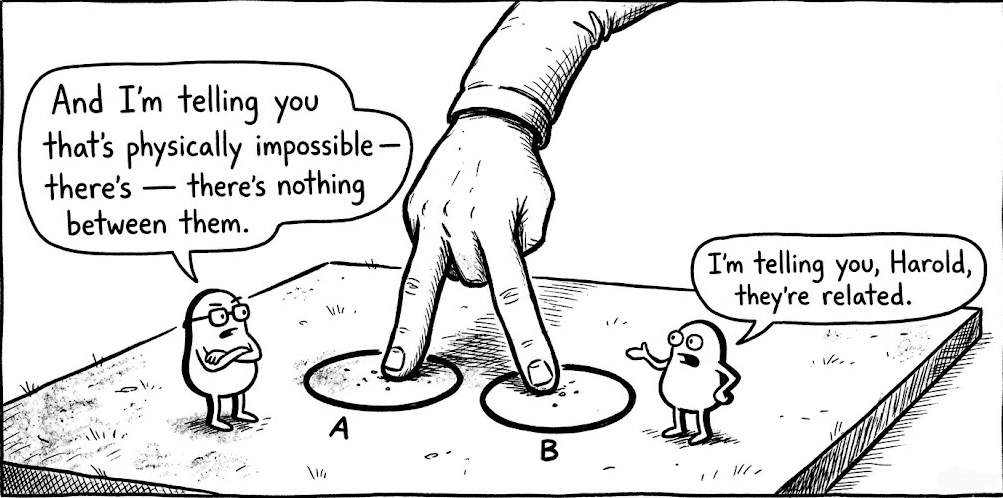
We might be two-dimensional beings trying to describe a three-dimensional hand by cataloguing the circles where the fingers pass through our plane. The physicist measures the circles. The philosopher argues from the circles' behavior that they must be connected. Al-Khalili points out that the circles seem to have been there the whole time, even before we looked. The actual structure of the hand remains outside all their planes.
But here is what I find genuinely remarkable, and let me say it plainly because the recursive apparatus of this essay's style can, if I'm not careful, become a way of hedging everything into vapor: three entirely independent traditions of inquiry, separated by seven centuries, operating with completely different methods (differential geometry and abstract algebra on one side; Aristotelian act/potency and the metaphysics of composition on the other; and now quantum foundations and the problem of time's arrow on a third), have converged on the same structural insight.
The experienced world is not the bottom layer. It is emergent. It is sustained. It hangs from something. And whatever that something is, it doesn't have the features of the world it sustains: not spatial, not temporal, not material, not composite. It is, in a word all three traditions might cautiously accept, fundamental.
Whether "fundamental" is another word for "God" is a question I'm going to leave here, on this table, between us, like a glass of water that neither of us is quite willing to pick up, partly because of what it means to hold it, and partly (if Aquinas is right) because of what it means to ask what's holding us.
Sources:
"Modern physics is forcing us to rethink existence | Michelle Thaller: Full Interview." Big Think, YouTube. Watch here
"An atheist explains the most convincing argument for God | Alex O'Connor." Big Think, YouTube. Watch here
"Quantum entanglement and the illusion of time, in 79 minutes | Jim Al-Khalili: Full Interview." Big Think, YouTube. Watch here
Footnotes
-
YouTube has a button that says 'Save to Watch Later,' which I have pressed hundreds of times and which has never once resulted in me watching something later. Except here. ↩
-
O'Connor is drawing on a distinction Aquinas made in the Summa Theologica and that Duns Scotus later sharpened, between per se (essentially) and per accidens (accidentally) ordered causal series. I'm using O'Connor's terminology because it's clearer and because deploying medieval Latin in a blog post feels like wearing a cummerbund to a barbecue. ↩
-
Edward Feser, who has done more than anyone to revive the Thomistic argument for contemporary audiences, wrote in 2011 that the typical online "refutation" of Aquinas refutes something Aquinas didn't argue, and that the typical online "defense" defends something Aquinas didn't claim. A perfect symmetry of mutual incomprehension. You have to admire it, in the way you admire any structure that achieves a kind of formal elegance. ↩
-
I am aware that "broke" is doing a lot of work in that sentence and that a professional philosopher would prefer "the aggregate causal power of a purely instrumental series with no non-instrumental first member is necessarily null," but "broke" communicates the same thing with fewer syllables and better timing, and I have chosen my loyalties. ↩
-
The word "gap" is interesting here. We use it as though gaps are real things, containers of distance that exist between objects. But if distance is itself emergent from entanglement, a gap isn't a thing. A gap is the absence of a thing, specifically the absence of entanglement. We have a word for "no gap" but no word for what the gap was pretending to be. ↩
-
A caveat that physicists will want noted: AdS/CFT describes a universe with a negative cosmological constant (anti-de Sitter space), and ours has a positive one (de Sitter space). This is not a minor asterisk. Extending these results to our actual universe is one of the major open problems in the field, and Takayanagi's January 2023 paper explicitly identifies it as such. The convergence I'm describing rests on the broader principle that entanglement and spatial geometry are linked, which multiple independent results (Van Raamsdonk, ER=EPR, the 2024 operational theorem, Leutheusser-Liu) now support across different frameworks. But the caveat should be visible, and now it is. ↩
-
The word "hologram" technically refers to a two-dimensional surface that encodes three-dimensional information, which means every gift shop hologram sticker has been a more accurate model of the universe than anything in the physics textbooks next to it. ↩
-
The Flatland analogy originates with Edwin Abbott's 1884 novella Flatland: A Romance of Many Dimensions, which is (a) genuinely brilliant, (b) unintentionally hilarious in its Victorian class satire, and (c) roughly 80 pages long, making it the rare piece of 19th-century literature you can finish without needing a snack break. Carl Sagan later used it to explain higher dimensions, and it has since become the single most deployed analogy in popular physics writing, a fact which, if Abbott could know it, would either delight or horrify him, given that he wrote the book as social criticism and not as a physics teaching tool. The universe is full of things being used for purposes other than what they were made for. This may itself be a kind of argument. ↩
-
Physicists have been calling their hypothetical observers "Alice and Bob" since Rivest, Shamir, and Adleman used the names in their landmark 1978 cryptography paper. The convention spread from cryptography to quantum mechanics to information theory with the quiet inevitability of a dress code at a prestigious club: nobody voted on it, nobody enforces it, and yet somehow everybody complies. Alice and Bob have now been entangled, teleported, separated by event horizons, dropped into black holes, and forced to communicate exclusively through quantum channels in thousands of published papers. At some point in the early 2000s the community added "Eve" (an eavesdropper), "Charlie" (a third party), and "Mallory" (a malicious actor), giving the cast the energy of a soap opera whose plot is expressed entirely in Hilbert spaces. ↩
-
The 2024 paper (Fields, Glazebrook, Marcianò, and Zappala) uses the word "theorem" in its title: "ER = EPR is an operational theorem." What they proved is narrower than "ER=EPR is true in general": they proved that within a specific operational setting (a two-agent LOCC protocol with a holographic boundary), entanglement and wormhole connection are indistinguishable. The full ER=EPR conjecture in its most general form remains a conjecture. The distinction matters because the essay has otherwise been careful about epistemic status, and it would be a shame to fumble the epistemics on a point this central. ↩
-
To be fair to myself (a phrase that, in the context of an essay about the fundamental nature of reality, reveals a certain scale of priorities), I had mentioned Takayanagi's January 2023 paper on the emergence of time. But treating it as a single sentence was a bit like writing a restaurant review that discusses the appetizers in exhaustive detail and then notes that they also serve entrees. ↩
-
Al-Khalili uses music to illustrate how "now" is a construction: you can't hear a melody in a single instant, because a melody requires you to hold previous notes in short-term memory while perceiving the current one. The "now" in which music exists is at least several seconds wide, and it's built by your brain, not the universe. Once you hear this, it retroactively ruins your ability to enjoy a concert without thinking about epistemology. ↩
-
"The equation that describes the quantum state of the entire universe" is a phrase I've just typed. It has a certain casual enormity, like saying "the recipe for everything" or "the pasta bowl of all existence." Physicists deploy phrases like this with the practiced nonchalance of people who have been living with the enormity for so long they've forgotten it's enormous. ↩
-
There is something almost comedic about the precision with which Aquinas appears to have anticipated this. Writing in the 1260s, with no knowledge of relativity, quantum mechanics, or the Wheeler-DeWitt equation, he concluded through purely philosophical reasoning that the sustaining ground of reality must be timeless, spaceless, simple, and immaterial. When you encounter a 13th-century Dominican friar who appears to have predicted the conceptual framework of 21st-century quantum gravity, the range of available responses is narrow. You can conclude he got lucky, which feels inadequate. You can conclude the philosophical reasoning was sound and correctly identified structural features of reality that physics later confirmed, which feels like a lot. Or you can conclude that both the philosophy and the physics are tracking the same underlying truth through different instruments, which is the option I keep circling back to and the one that makes me most nervous, because it has implications I haven't figured out how to sit with yet. ↩
-
A caveat: "time is emergent" is one of those phrases that sounds profound in a way that can slide past without actually reckoning with what it claims. It claims that the experience of one moment following another, the feeling that you are reading this word after the previous word, the entire machinery of "before" and "after" on which causation, memory, narrative, and consciousness depend, is not a fundamental feature of reality but a secondary phenomenon produced by something that doesn't experience sequence at all. If that sounds like mysticism, it might be worth noting that the people saying it are the same people who correctly predicted the mass of the Higgs boson. ↩
-
The philosopher gets irritated because you're taking a metaphysical argument that was designed to work independently of any particular physical theory and yoking it to one, which means that if the physics changes (and physics always changes), the argument looks like it goes down with the ship, even though the whole point is that it was never on the ship. The physicist gets irritated because you're taking a rigorous mathematical framework and treating it as grist for a question ("But what does it MEAN?") that the framework was specifically constructed to avoid having to answer. Both irritations are legitimate. I am proceeding anyway. ↩
-
I will note that the Vedantic tradition not only matches the physicist's attribute list but goes further, which is worth noting even if I can't resolve it. The Upanishads describe Brahman as Sat-Chit-Ananda: existence, consciousness, bliss. The first matches both the physicist and the Thomist. The second (consciousness) is precisely the kataphoric attribute that the physicist's foundation lacks and the philosopher's foundation possesses (Aquinas's Pure Act has intellect). The third (bliss) is in yet a different category. Whether this broader convergence strengthens the case or merely shows that the pattern-matching can be made to match anything is a question I don't have the equipment to answer from inside this essay. ↩